

Current events
Next talk tomorrow at 11:30 by Yiheng Li!
News 05.06.2026
New publication: Real-time camera experiments with phyphox
Site Content:
08.07.2015
New publication: Graphene spintronics: the European Flagship perspective
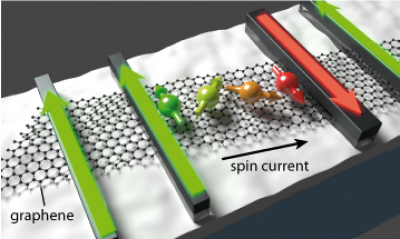
2D Mater. 2, 030202 (2015)
We review current challenges and perspectives in graphene spintronics, which is one of the most promising directions of innovation, given its room-temperature long-spin lifetimes and the ability of graphene to be easily interfaced with other classes of materials (ferromagnets, magnetic insulators, semiconductors, oxides, etc.), allowing proximity effects to be harvested. The general context of spintronics is first discussed together with open issues and recent advances achieved by the Graphene Spintronics Work Package consortium within the Graphene Flagship project. Based on such progress, which establishes the state of the art, several novel opportunities for spin manipulation such as the generation of pure spin current (through spin Hall effect) and the control of magnetization through the spin torque phenomena appear on the horizon. Practical applications are within reach, but will require the demonstration of wafer-scale graphene device integration, and the realization of functional prototypes employed for determined applications such as magnetic sensors or nano-oscillators. This is a specially commissioned editorial from the Graphene Flagship Work Package on Spintronics. This editorial is part of the 2D materials focus collection on ‘Progress on the science and applications of two dimensional materials,’ published in association with the Graphene Flagship. It provides an overview of key recent advances of the spintronics work package as well as the mid-term objectives of the consortium.

10.06.2015
New publication: Switchable Coupling of Vibrations to Two-Electron Carbon-Nanotube Quantum Dot States
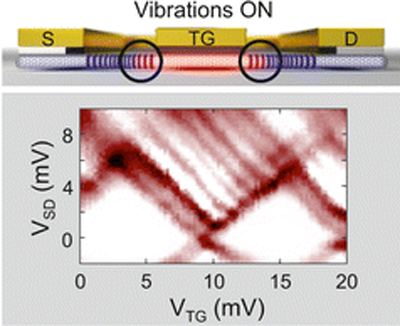
Nano Lett. 15, 4417 (2015)
We report transport measurements on a quantum dot in a partly suspended carbon nanotube. Electrostatic tuning allows us to modify and even switch “on” and “off” the coupling to the quantized stretching vibration across several charge states. The magnetic-field dependence indicates that only the two-electron spin-triplet excited state couples to the mechanical motion, indicating mechanical coupling to both the valley degree of freedom and the exchange interaction, in contrast to standard models.
13.05.2015
New publication: Ultra-sensitive Hall sensors based on graphene encapsulated in hexagonal boron nitride
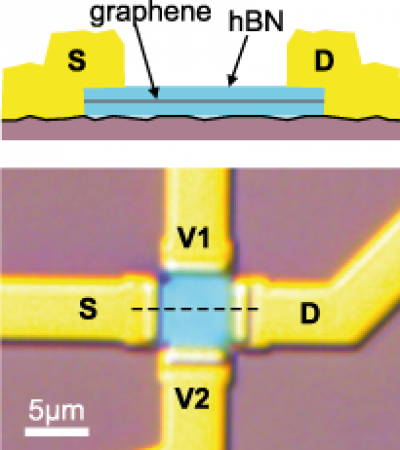
Appl. Phys. Lett. 106, 193501 (2015)
The encapsulation of graphene in hexagonal boron nitride provides graphene on substrate with excellent material quality. Here, we present the fabrication and characterization of Hall sensor elements based on graphene boron nitride heterostructures, where we gain from high mobility and low charge carrier density at room temperature. We show a detailed device characterization including Hall effect measurements under vacuum and ambient conditions. We achieve a current- and voltage-related sensitivity of up to 5700 V/AT and 3 V/VT, respectively, outpacing state-of-the-art silicon and III/V Hall sensor devices. Finally, we extract a magnetic resolution limited by low frequency electric noise of less than 50 nT/ (Hz)1/2 making our graphene sensors highly interesting for industrial applications.
26.04.2015
Nanoelectronic Days 2015
From Monday, 27 April till Thursday, 30 April 2015 at the Forschungszentrum Jülich. For more information please see http://www.jara.org/de/research/jara-fit/nanoelectronic-days/.
07.04.2015
New publication: Contact-induced charge contributions to non-local spin transport measurements in Co/MgO/graphene devices
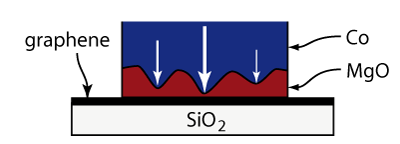
2D Materials 2, 024001 (2015)
Recently, it has been shown that oxide barriers in graphene-based non-local spin-valve structures can be the bottleneck for spin transport. The barriers may cause spin dephasing during or right after electrical spin injection which limits spin transport parameters such as the spin lifetime of the whole device. An important task is to characterize the quality of the oxide barriers of both spin injection and detection contacts in a fabricated device. To address this issue, we discuss the influence of spatially inhomogeneous oxide barriers and especially conducting pinholes within the barriers on the background signal in non-local measurements of graphene/MgO/Co spin-valve devices. By both simulations and reference measurements on devices with non-ferromagnetic electrodes, we demonstrate that the background signal can be caused by an inhomogeneous current flow through the oxide barriers. As a main result, we demonstrate the existence of charge accumulation besides the actual spin accumulation signal in non-local voltage measurements, which can be explained by a redistribution of charge carriers by a perpendicular magnetic field similar to the classical Hall effect. Furthermore, we present systematic studies of the phase of the low frequency non-local ac voltage signal which is measured in non-local spin measurements when applying ac lock-in techniques. This phase has so far widely been neglected in the analysis of non-local spin transport. We demonstrate that this phase is another hallmark of the homogeneity of the MgO spin injection and detection barriers. We link backgate dependent changes of the phase to the interplay between the capacitance of the oxide barrier and the quantum capacitance of graphene.
29.03.2015
Poster prize for Luca Banszerus
Luca Banszerus won a poster prize at the "Graphene Study 2015" in Kaprun (Austria). Congratulation!
11.02.2015
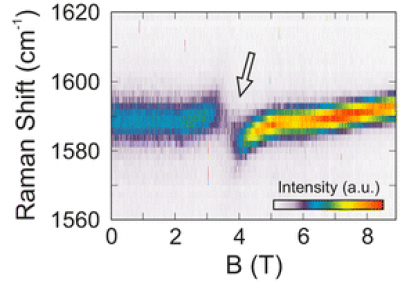
New publication: Low B Field Magneto-Phonon Resonances in Single-Layer and Bilayer Graphene
Nano Lett. 15, 1547 (2015)
Many-body effects resulting from strong electron–electron and electron–phonon interactions play a significant role in graphene physics. We report on their manifestation in low B field magneto-phonon resonances in high-quality exfoliated single-layer and bilayer graphene encapsulated in hexagonal boron nitride. These resonances allow us to extract characteristic effective Fermi velocities, as high as 1.20 × 10⁶ m/s, for the observed “dressed” Landau level transitions, as well as the broadening of the resonances, which increases with the Landau level index.