

Current events
Next talk tomorrow at 11:30 by Yiheng Li!
News 05.06.2026
New publication: Real-time camera experiments with phyphox
Site Content:
27.08.2015
New publication: Nanosecond spin lifetimes in bottom-up fabricated bilayer graphene spin-valves with atomic layer deposited Al2O3 spin injection and detection barriers
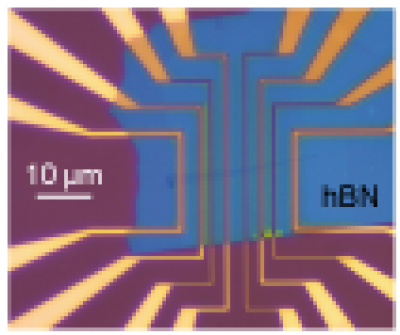
Physica Status Solidi B (online)
We present spin transport studies on bi- and trilayer graphene
non-local spin-valves which have been fabricated by a bottomup
fabrication method. By this technique, spin injection electrodes
are first deposited onto Si++/SiO2 substrates with subsequent
mechanical transfer of a graphene/hBN heterostructure.
We showed previously that this technique allows for nanosecond
spin lifetimes at room temperature combined with carrier
mobilities which exceed 20,000 cm2Vs)−1. Despite strongly
enhanced spin and charge transport properties, the MgO injection
barriers in these devices exhibit conducting pinholes which
still limit the measured spin lifetimes.We demonstrate that these
pinholes can be partially diminished by an oxygen treatment of
a trilayer graphene device which is seen by a strong increase of
the contact resistance area products of the Co/MgO electrodes.
At the same time, the spin lifetime increases from 1 to 2 ns.We
believe that the pinholes partially result from the directional
growth in molecular beam epitaxy. For a second set of devices,
we therefore used atomic layer deposition of Al2O3 which offers
the possibility to isotropically deposit more homogeneous barriers.
While the contacts of the as-fabricated bilayer graphene
devices are non-conductive, we can partially break the oxide
barriers by voltage pulses. Thereafter, the devices also exhibit
nanosecond spin lifetimes.

21.08.2015
Sowmya Somanchi wins the „Falling Walls Lab Jülich“ competition
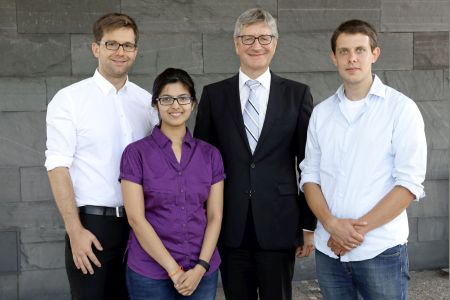
Sowmya Somanchi wins the 2015 „Falling Walls Lab Jülich“ competition. Under the slogan "Great Minds - 3 Minutes - 1 Day" 15 young scientsits did their best to convince the jury by a 3 minunts talk on their own research topic. Sowmya is now invited to the "Falling Walls Conference" on the 8th und 9th November in Berlin.
For more information please see:
Pressemitteilung Forschungszentrum Jülich.
Alexander Braun (1.v.l.), Sowmya Somanchi (2.v.l.) und Moritz Nabel (rechts) fahren zum Finale und zur "Falling Walls Conference" nach Berlin. Prof. Wolfgang Marquardt (2.v.r.), Vorstandsvorsitzender des Forschungszentrums, war Mitglied der Jury des ersten "Falling Walls Lab Jülich".
Copyright: Forschungszentrum Jülich.
20.08.2015
"High-quality delamination" - Research Highlights, Nature Materials, 14, 857 (2015)
Our recent work published in Science Advances has been highlighted by Nature Materials: "High-quality delamination" - Research Highlights, Nature Materials 14, 857 (2015).
17.08.2015
New publication: Phase-coherent transport in catalyst-free vapor phase deposited Bi2Se3 crystals
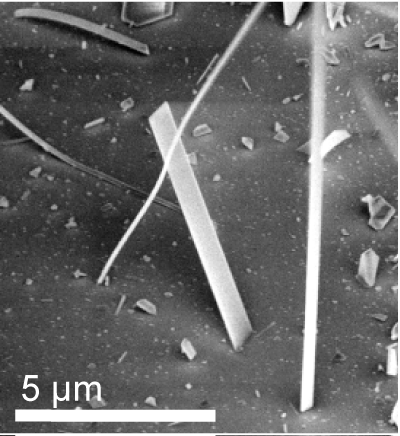
Phys. Rev. B 92, 085417 (2015)
Freestanding Bi2Se3 single-crystal flakes of variable thicknesses are grown using a catalyst-free vapor-solid synthesis and are subsequently transferred onto a clean Si++/SiO2 substrate where the flakes are contacted in Hall bar geometry. Low-temperature magnetoresistance measurements are presented which show a linear magnetoresistance for high magnetic fields and weak antilocalization (WAL) at low fields. Despite an overall strong charge-carrier tunability for thinner devices, we find that electron transport is dominated by bulk contributions for all devices. Phase-coherence lengths lϕ as extracted from WAL measurements increase linearly with increasing electron density exceeding 1μm at 1.7 K. Although lϕ is in qualitative agreement with electron-electron interaction-induced dephasing, we find that spin-flip scattering processes limit lϕ at low temperatures.
14.08.2015
Poster prize for Luca Banszerus at Carbonhagen 2015
Luca Banszerus won with his contribution on "High mobility and ballistic transport in graphene by chemical vapor deposition" the Poster prize at the Carbonhagen 2015 in Kopenhagen (Dänemark).
14.08.2015
New publication: Uniformity of the pseudomagnetic field in strained graphene
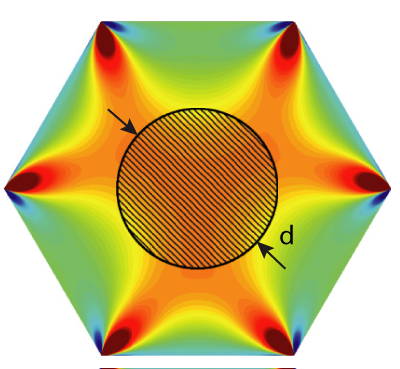
Phys. Rev. B 92, 075417(2015)
We present a numerical study on the uniformity of the pseudomagnetic field in graphene as a function of the relative orientation between the graphene lattice and straining directions. We calculated the deformation of a regular micron-sized graphene hexagon by symmetrically displacing three of its edges. We found that the pseudomagnetic field is strongest if the strain is applied perpendicular to the armchair direction of graphene. For a hexagon with a side length of 1μm, the pseudomagnetic field has a maximum of 1.2 T for an applied strain of 3.5% and it is uniform (variance <1%) within a circle with a diameter of ∼520 nm. This diameter is on the order of the typical diameter of the laser spot in a state-of-the-art confocal Raman spectroscopy setup, which suggests that observing the pseudomagnetic field in measurements of shifted magnetophonon resonance is feasible.
06.08.2015
"Scaling up pure graphene growth" - Research Highlights, Nature, 524, 9, (2015)
Our recent work published in Science Advances has been highlighted by Nature: "Scaling up pure graphene growth" - Research Highlights, Nature 524, 9 (2015).
31.07.2015
New publication: Ultrahigh-mobility graphene devices from chemical vapor deposition on reusable copper
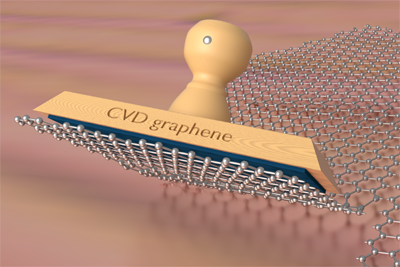
Science Advances 1, e1500222 (2015)
Graphene research has prospered impressively in the past few years, and promising applications such as highfrequency
transistors, magnetic field sensors, and flexible optoelectronics are just waiting for a scalable and costefficient
fabrication technology to produce high-mobility graphene. Although significant progress has been
made in chemical vapor deposition (CVD) and epitaxial growth of graphene, the carrier mobility obtained with
these techniques is still significantly lower than what is achieved using exfoliated graphene. We show that the
quality of CVD-grown graphene depends critically on the used transfer process, and we report on an advanced
transfer technique that allows both reusing the copper substrate of the CVD growth and making devices with
mobilities as high as 350,000 cm2 V–1 s–1, thus rivaling exfoliated graphene.