
Current events
Talk today at 10:00 by Simon Kopf!
News 11.09.2026
Ananya Singh wins 3rd Poster Prize at the ML4Q Annual Conference
Site Content:
08.12.2025
New publication: MaskTerial: a foundation model for automated 2D material flake detection
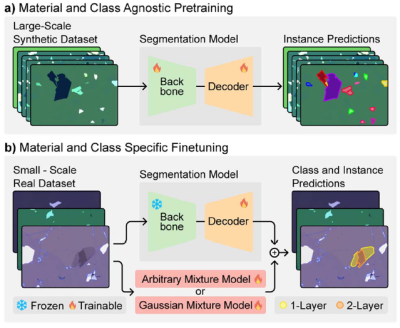
Digital Discovery 4, 3744(2025) The detection and classification of exfoliated two-dimensional (2D) material flakes from optical microscope images can be automated using computer vision algorithms. This has the potential to increase the accuracy and objectivity of classification and the efficiency of sample fabrication, and it allows for large-scale data collection. Existing algorithms often exhibit challenges in identifying low-contrast materials and typically require large amounts of training data. Here, we present a deep learning model, called MaskTerial, that uses an instance segmentation network to reliably identify 2D material flakes. The model is extensively pre-trained using a synthetic data generator that generates realistic microscopy images from unlabeled data. This results in a model that can quickly adapt to new materials with as little as 5 to 10 images. Furthermore, an uncertainty estimation model is used to finally classify the predictions based on optical contrast. We evaluate our method on eight different datasets comprising five different 2D materials and demonstrate significant improvements over existing techniques in the detection of low-contrast materials such as hexagonal boron nitride.

14.11.2025
RWTH’s “5 to 12” Science Night
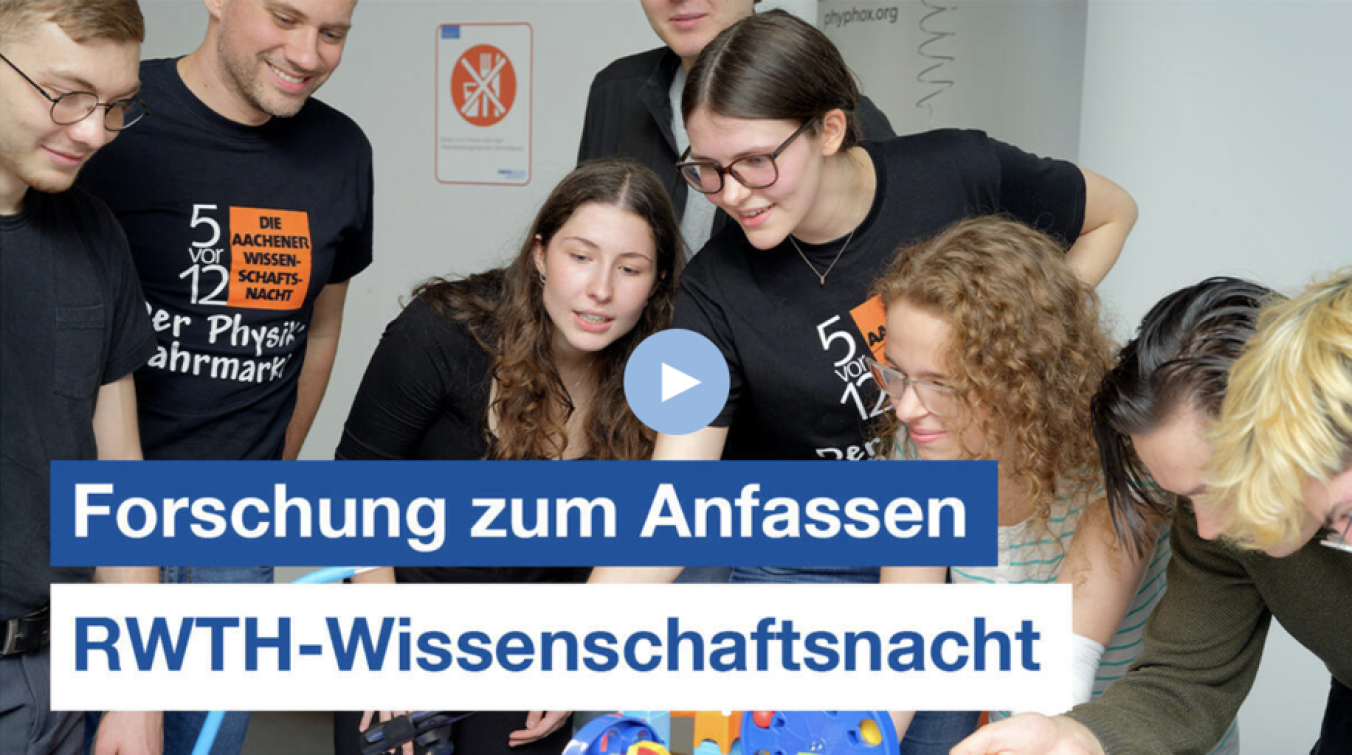
Once again, the Wissenschaftsnacht at RWTH Aachen proved to be a resounding success! This year, as in previous years, many members of our group contributed their time and expertise to make the evening a memorable experience for visitors.
Please find here a link to a youtube-video about it: "5 vor 12" - Die RWTH-Wissenschaftsnacht 2025
11.11.2025
New publication: Tailoring Phonon Polaritons in hBN with the Plasmonic Phase-Change Material In3SbTe2

Nano Letters 25, 15809 (2025) Polaritons in van-der-Waals materials (vdWMs) promise high confinement and multiple tailoring options by resonators and launching structures which conventionally require cumbersome lithography techniques. Optical programming of phase-change materials (PCMs) offers fast and reconfigurable fabrication of these structures. As the plasmonic PCM In3SbTe2 can be switched between a dielectric and metallic phase, In3SbTe2 is promising for optical programming of metallic launching structures to tailor and confine polaritons in vdWMs. Here, we combine the vdWM hexagonal boron nitride (hBN) with In3SbTe2 and optically program circular resonators for hBN’s phonon polaritons into In3SbTe2. We investigate the polariton resonators with near-field optical microscopy. Demonstrating the reconfigurability, we decrease the resonator diameter to increase the confinement up to λ/39 and achieve a quality factor of 72. Finally, we fabricate a focusing structure for hBN’s polaritons whose focal point we reconfigure. We promote In3SbTe2 as a versatile platform for rapid prototyping of polariton optics in vdWMs.
03.11.2025
Robin Dollemann Starts as Assistant Professor at HFML-FELIX in Nijmegen
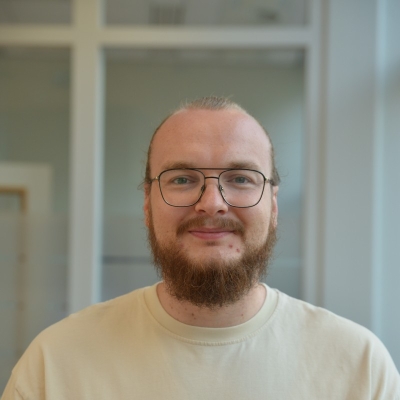
We are happy to share that Robin Dollemann, former postdoc in our group, has started his new position as Assistant Professor at HFML-FELIX in Nijmegen, Gelderland, Netherlands. His work will focus on developing fabrication methods for 2D materials and on low-temperature transport experiments in high magnetic fields.
Congratulations, Robin, on this exciting next step. We wish you a great start and all the best for this new chapter!
28.10.2025
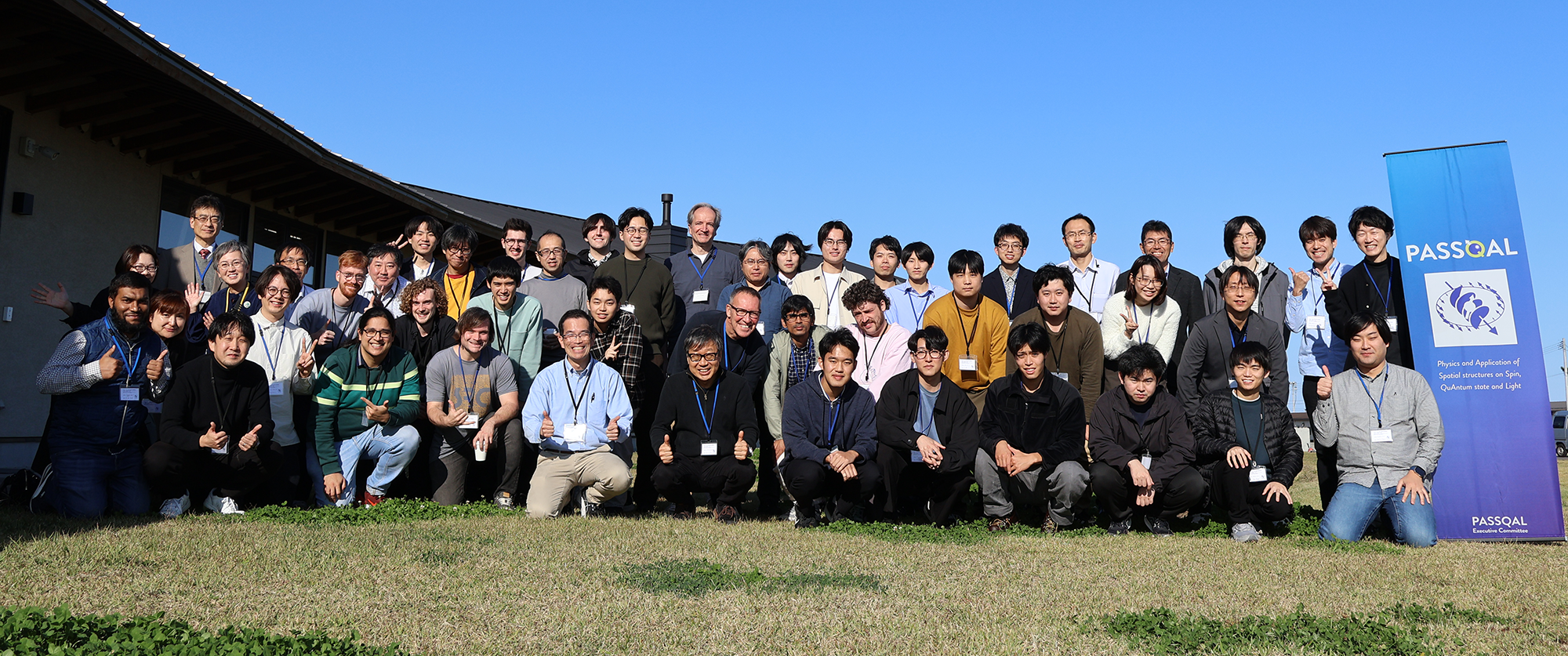
Visit of PASSQAL workshop in Sendai
Bernd Beschoten gave a talk on the magnetic phases in bilayer graphene at the 2nd PASSQAL Workshop in Sendai. The workshop on "physics and application of spatial structures on spin, quantum state and light" was hosted by Prof. Makoto Kohda from Tohoku University.
30.09.2025
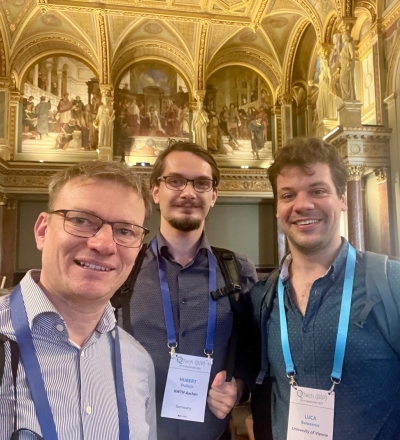
Bilayer Graphene Quantum Dots at QTech-Bp in Budapest
Two of our group members, Hubert Dulisch and Christoph Stampfer, presented the recent results on bilayer graphene quantum dots in the SpinQubits workshop at the QTech-Bp meeting in Budapest. The conference was hosted at the Hungarian Academy of Sciences (an impressive building), celebrating its 200th anniversary alongside 100 years of quantum mechanics. Besides the stimulating scientific program, we had great fun reconnecting with former group members.
15.09.2025
Our group at the 2nd DPG Fall Meeting: 100 Years of Quantum Physics
Christian Volk and Christoph Stampfer from our group actively participated in the 2nd DPG-Herbsttagung 100 Years of Quantum Physics, held from 8–12 September 2025 at Georg-August-Universität Göttingen. Their contributions highlighted our ongoing research quantum dots in bilayer graphene. We are happy to have been part of this special event marking the International Year of Quantum.
09.09.2025
PhD anniversary
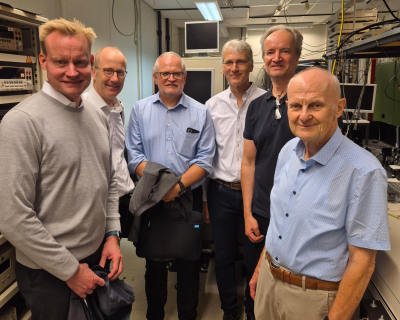
As part of this year’s RWTH anniversary celebration of the 1999 graduating class, it was a great pleasure for us to welcome some of the former graduates back to the research facility of the 2nd Institute of Physics. (The jubilarians from left to right: Dr. Michael Fischer, Dr. Frank Dillmann, Dr. Jochen Dreßen, Dr. Andreas Rosenberger. Hosts at the institute: Dr. Bernd Beschoten and Prof. Dr. emer. Gernot Güntherodt)."