

Current events
Next talk on Tuesday in 3 days by Yiheng Li.
News 05.06.2026
New publication: Real-time camera experiments with phyphox
Site Content:
10.08.2018
New publication: Detecting Ultrasound Vibrations with Graphene Resonators
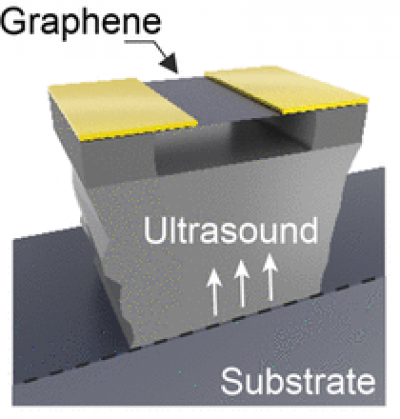
Nano Lett. 18, 5132 (2018) Ultrasound detection is one of the most-important nondestructive subsurface characterization tools for materials, the goal of which is to laterally resolve the subsurface structure with nanometer or even atomic resolution. In recent years, graphene resonators have attracted attention for their use in loudspeakers and ultrasound radios, showing their potential for realizing communication systems with air-carried ultrasound. Here, we show a graphene resonator that detects ultrasound vibrations propagating through the substrate on which it was fabricated. We ultimately achieve a resolution of ∼7 pm/(Hz)1/2 in ultrasound amplitude at frequencies up to 100 MHz. Thanks to an extremely high nonlinearity in the mechanical restoring force, the resonance frequency itself can also be used for ultrasound detection. We observe a shift of 120 kHz at a resonance frequency of 65 MHz for an induced vibration amplitude of 100 pm with a resolution of 25 pm. Remarkably, the nonlinearity also explains the generally observed asymmetry in the resonance frequency tuning of the resonator when it is pulled upon with an electrostatic gate. This work puts forward a sensor design that fits onto an atomic force microscope cantilever and therefore promises direct ultrasound detection at the nanoscale for nondestructive subsurface characterization.

06.08.2018
Gerard Verbiest started as Assistant Professor

Gerard Verbiest left our group and started on 1 August 2018 as Assistant Professor at the Department of Precision and Microsystems Engineering (PME) at TU Delft (Netherlands). We wish him every success!
24.07.2018
New publication: Fabrication of comb-drive actuators for straining nanostructured suspended graphene
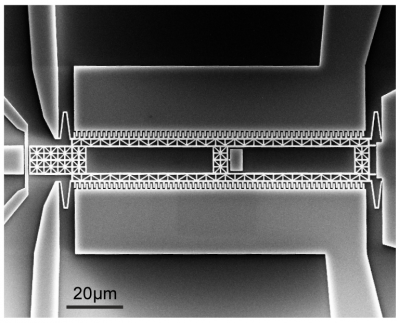
Nanotechnology 29, 375301 (2018) We report on the fabrication and characterization of an optimized comb-drive actuator design for strain-dependent transport measurements on suspended graphene. We fabricate devices from highly p-doped silicon using deep reactive ion etching with a chromium mask. Crucially, we implement a gold layer to reduce the device resistance from ≈51.6 kΩ to ≈236 Ω at room temperature in order to allow for strain-dependent transport measurements. The graphene is integrated by mechanically transferring it directly onto the actuator using a polymethylmethacrylate membrane. Importantly, the integrated graphene can be nanostructured afterwards to optimize device functionality. The minimum feature size of the structured suspended graphene is 30 nm, which allows for interesting device concepts such as mechanically-tunable nanoconstrictions. Finally, we characterize the fabricated devices by measuring the Raman spectrum as well as the a mechanical resonance frequency of an integrated graphene sheet for different strain values
10.07.2018
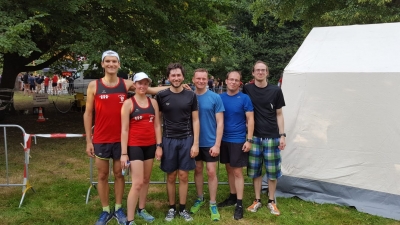
Lousberglauf
Following our tradition, members of our Institute participated at the "Lousberglauf 2018”. Withstanding the gruesome heat, Michael (21:15), Markus (23:15), Benedikt (25:53), Alex (26:06) and Christoph (29:51) finished the challenging course together with over 1800 other participants. Congratulations!
28.06.2018
International Master's program in physics: Promotional video
The international Master's program in Physics is a two years program. The first year consists of lectures, seminars and lab courses. The second year is dedicated to an individual research project.
16.05.2018
New publication: Advanced tools for smartphone-based experiments: phyphox
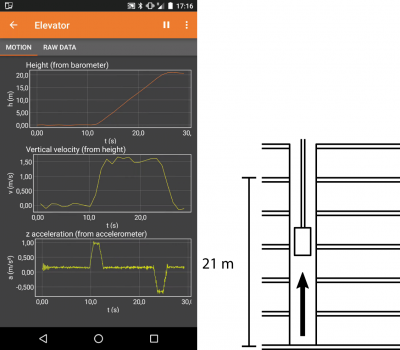
Physics Education 53, 045009 (2018) The sensors in modern smartphones are a promising and cost-effective tool for experimentation in physics education, but many experiments face practical problems. Often the phone is inaccessible during the experiment and the data usually needs to be analyzed subsequently on a computer. We address both problems by introducing a new app, called "phyphox", which is specifically designed for utilizing experiments in physics teaching. The app is free and designed to offer the same set of features on Android and iOS.
04.05.2018
New publication: Impact of Many-Body Effects on Landau Levels in Graphene
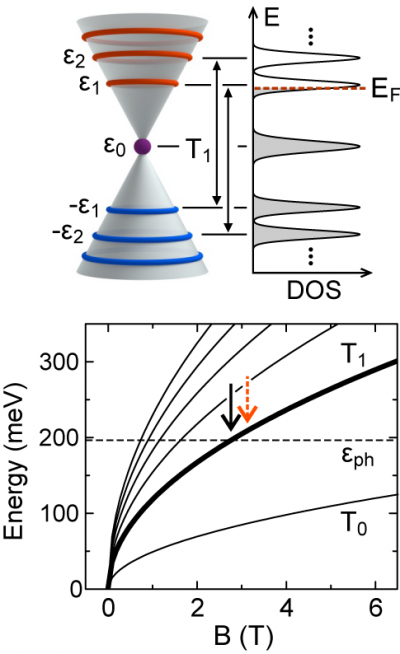
Phys. Rev. Lett. 120, 187701(2018) We present magneto-Raman spectroscopy measurements on suspended graphene to investigate the charge carrier density-dependent electron-electron interaction in the presence of Landau levels. Utilizing gate-tunable magnetophonon resonances, we extract the charge carrier density dependence of the Landau level transition energies and the associated effective Fermi velocity vF. In contrast to the logarithmic divergence of vF at zero magnetic field, we find a piecewise linear scaling of F as a function of the charge carrier density, due to a magnetic-field-induced suppression of the long-range Coulomb interaction. We quantitatively confirm our experimental findings by performing tight-binding calculations on the level of the Hartree-Fock approximation, which also allow us to estimate an excitonic binding energy of ≈6 meV contained in the experimentally extracted Landau level transitions energies.
02.05.2018
New publication: Time-resolved lateral spin-caloric transport of optically generated spin packets in n-GaAs
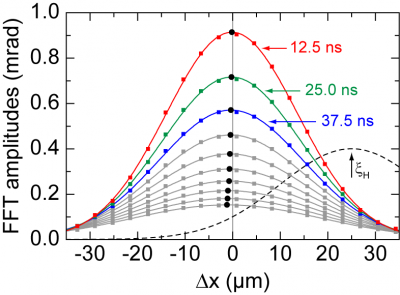
Journal of Physics D: Applied Physics 51, 214003(2018) We report on lateral spin-caloric transport (LSCT) of electron spin packets which are optically generated by ps laser pulses in the non-magnetic semiconductor n-GaAs at T < 35 K. LSCT is driven by a local temperature gradient induced by an additional cw heating laser. The spatio-temporal evolution of the spin packets is probed using time-resolved Faraday rotation. We demonstrate that the local temperature-gradient induced spin diffusion is solely driven by a non-equilibrium hot spin distribution, i.e. without involvement of phonon drag effects.