

Current events
Talk today at 11:00 by Adrian Miemczyk!
News 05.06.2026
New publication: Real-time camera experiments with phyphox
Site Content:
01.12.2018
Christoph Stampfer becomes a member of the board of trustees of the "Physik Journal"

Christoph Stampfer was elected as member of the board of trustees of the "Physik Journal" for the period 2019-2024.

07.11.2018
New publication including cover page: Smart Experiments
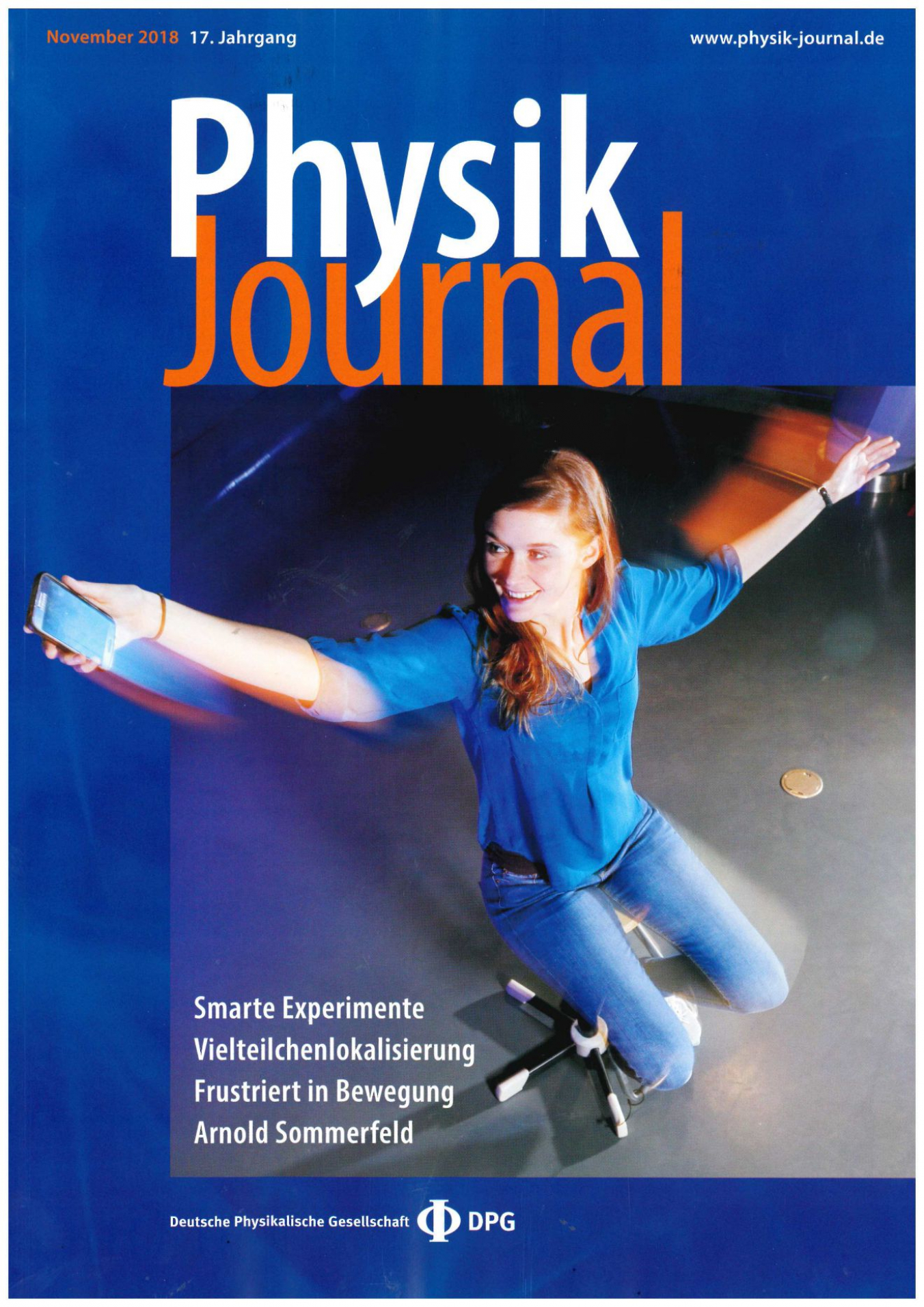
Lehre: Smarte Experimente - Physik Journal 11, 35 (2018) In den Vorlesungen zur Experimentalphysik lassen sich Smartphones sinnvoll einsetzen. In den meisten Physikstudiengängen bildet die Vorlesung zur Experimentalphysik die zentrale Einführung. Dabei stellen Studierende jedoch schnell fest, dass das „Experiment“ im Titel der Veranstaltung lediglich Demonstrationsversuchen geschuldet ist, sie aber nicht selbst experimentieren dürfen. Da es unmöglich ist, alle Studierenden mit Messgeräten auszustatten, schauen sie den Vorführungen passiv zu und bekommen erst in den physikalischen Praktika die Möglichkeit, selbst Versuche durchzuführen. Die eigenständige Experimentiererfahrung wird losgelöst vom Vorlesungsstoff gesammelt.
26.10.2018
Race report Köln Marathon 2018
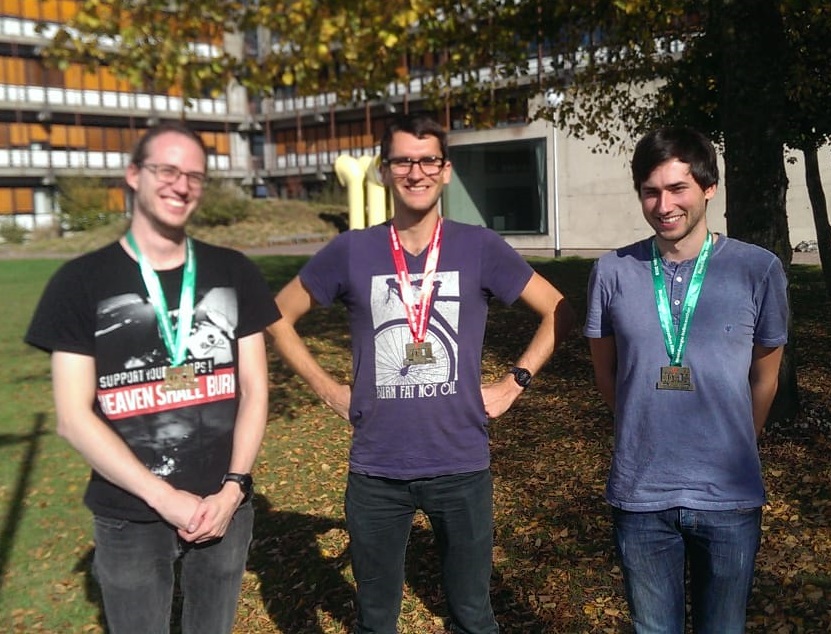
Our institute participated successfully at the "RheinEnergie Marathon" in Köln. Along with 27,000 other athletes, Markus (1:43:41), Alex (1:50:19) and Benedikt (1:51:40) completed the Half Marathon course while Michael ran the full Marathon in 3:04:34. Congratulations!
01.10.2018
New publication: Ultra-long wavelength Dirac plasmons in graphene capacitors
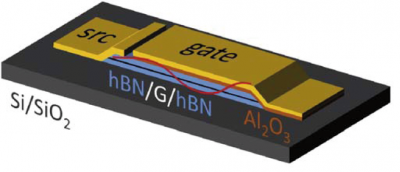
J. Phys. Mater. 1, 01LT02 (2018) Graphene is a valuable 2D platform for plasmonics as illustrated in recent THz and mid-infrared optics experiments. These high-energy plasmons however, couple to the dielectric surface modes giving rise to hybrid plasmon-polariton excitations. Ultra-long wavelengths address the low energy end of the plasmon spectrum, in the GHz–THz electronic domain, where intrinsic graphene Dirac plasmons are essentially decoupled from their environment. However experiments are elusive due to the damping by ohmic losses at low frequencies. We demonstrate here a plasma resonance capacitor (PRC) using hexagonal boron-nitride (hBN) encapsulated graphene at cryogenic temperatures in the near-ballistic regime. We report on a 100 μm quarter-wave plasmon mode, at 40 GHz, with a quality factor Q≅2. The accuracy of the resonant technique yields a precise determination of the electronic compressibility and kinetic inductance, allowing to assess residual deviations from intrinsic Dirac plasmonics. Our GHz frequency capacitor experiment constitutes a first step towards the demonstration of plasma resonance transistors for microwave detection in the sub-THz domain for wireless communication and sensing. It also paves the way to the realization of doping-modulated superlattices where plasmon propagation is controlled by Klein tunneling.
13.08.2018
Christoph Stampfer becomes a member of the local support committee of the Transducers 2019 – EUROSENSORS XXXIII
Next summer, in June 2019, EUROSENSORS XXXIII is combined with Transducers 2019 bringing together the sensors, actuators and microsystems experts from all over the world together in Berlin.
10.08.2018
New publication: Gate-Defined Electron–Hole Double Dots in Bilayer Graphene

Nano Lett. 18, 4785 (2018) We present gate-controlled single-, double-, and triple-dot operation in electrostatically gapped bilayer graphene. Thanks to the recent advancements in sample fabrication, which include the encapsulation of bilayer graphene in hexagonal boron nitride and the use of graphite gates, it has become possible to electrostatically confine carriers in bilayer graphene and to completely pinch-off current through quantum dot devices. Here, we discuss the operation and characterization of electron–hole double dots. We show a remarkable degree of control of our device, which allows the implementation of two different gate-defined electron–hole double-dot systems with very similar energy scales. In the single-dot regime, we extract excited state energies and investigate their evolution in a parallel magnetic field, which is in agreement with a Zeeman-spin-splitting expected for a g-factor of 2.